Please welcome our guest blogger Saarin, my friend and fellow dish collector to The Little Round Table for a series of posts first published in 2009. Join us each day from Dec 1-9 as Hanukkah is celebrated.
Saarin's son Noah's story of Hanukka began the series:
**************************
Tonight at sundown, the Jewish holiday of Hanukkah, the Festival of Lights, begins. This holiday is celebrated for eight nights in the month of Kislev on the Jewish calendar, coinciding with the winter holiday season. Hanukkah (also sometimes spelled Chanukah) is a celebration of religious freedom and the dedication of Jews all over the world to keep their traditions alive. Also, it brings light into our homes at the darkest time of the year.
As the story goes, after the destruction of the Temple in the year 165 BCE, there was only enough oil left to keep the "eternal flame" burning for one night. Miraculously, the oil lasted for eight nights, until more could be acquired. That's why Hanukkah is celebrated for eight nights, and why oil is a prominent part of the holiday.
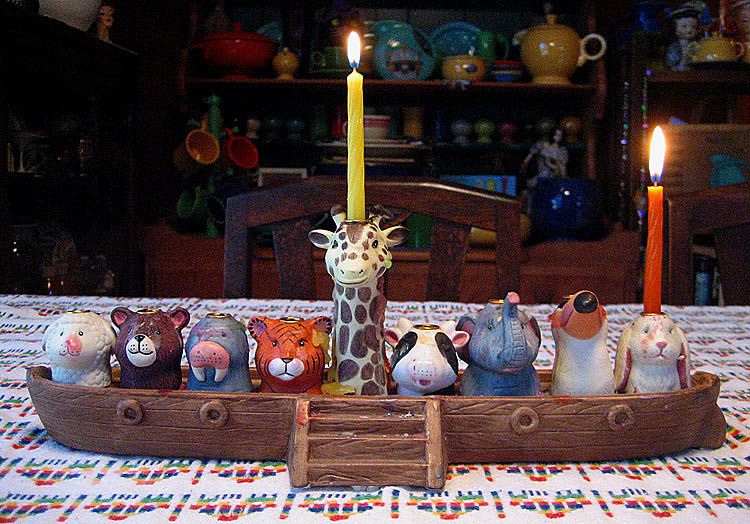
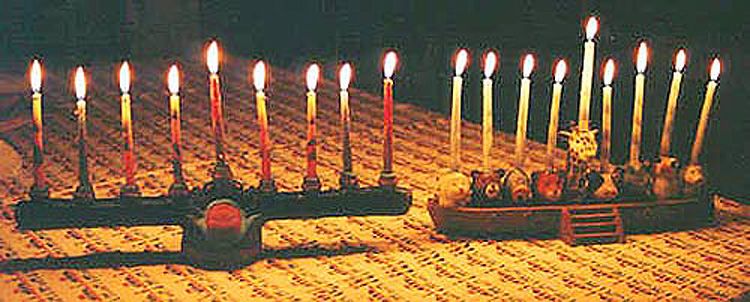
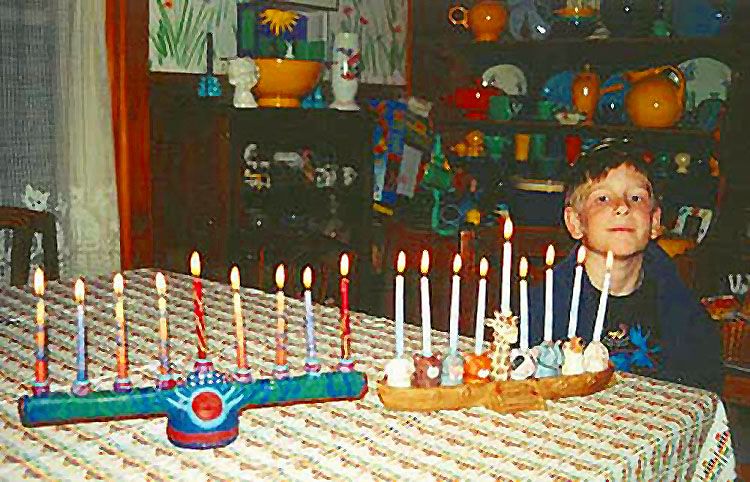
There are eight nights of Hanukkah, but nine candles in the menorah. The ninth candle is called the "shamash", or helper candle, and it is set apart from the rest. The shamash candle is lit first with a match, and then the shamash is used to light the other candles. On the first night, there is one candle plus the shamash, and another candle is added each night. The candles are added from right to left, the same direction in which the Hebrew language is read.
Jewish holidays begin at sundown, and that's when the menorah is lit. There are special blessings that are spoken or sung as the candles are lit, and they are allowed to burn all the way down.


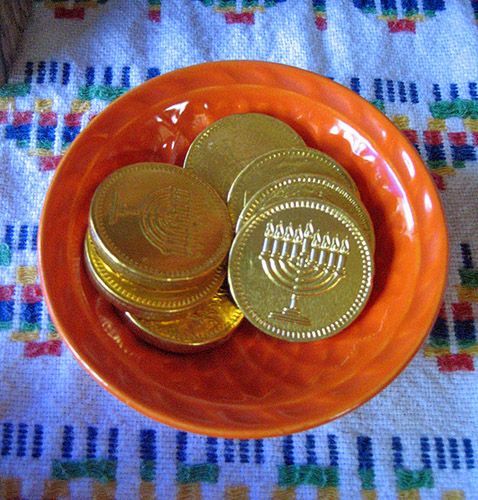
Families and friends gather, light the menorah (adding a candle each night), play games with tops called "dreidels" and chocolate coins, exchange gifts, and eat foods made with oil. Potato pancakes called "latkes" are a favorite treat. At my house, it has been a tradition for many years to invite the neighbors in for a potluck meal, light menorahs, and celebrate together. With a little help from my friends, I often prepare up to 100 latkes for the annual neighborhood gathering.
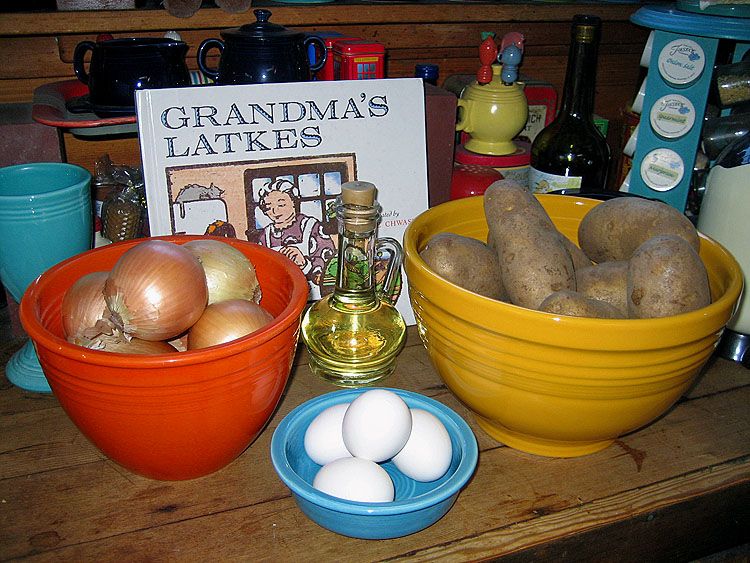
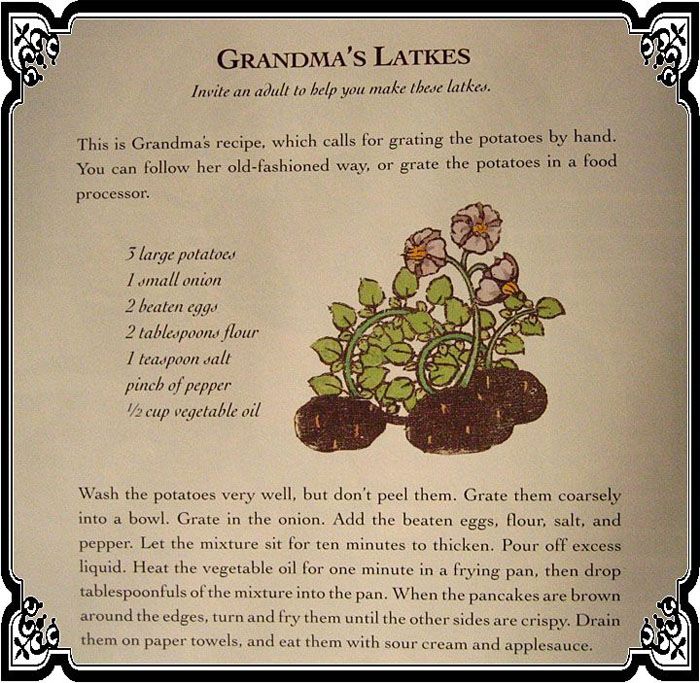
There are as many recipes for latkes as there are families who make them. When my son was small, I often read a book to him called "Grandma's Latkes" by Malka Drucker, illustrated by Eve Chwast (Harcourt, Brace, Jovanovich, 1992.) As well as its charming story about family tradition, the book offers a simple recipe, and it's the one I've always used to make my own latkes. There are just a few ingredients--potatoes, onions, a little flour, an egg or two, some salt and pepper, and oil. In this photo you'll see Fiesta dishes both old and new: a vintage red mixing bowl, a post-86 marigold baking bowl, and a vintage turquoise fruit bowl.


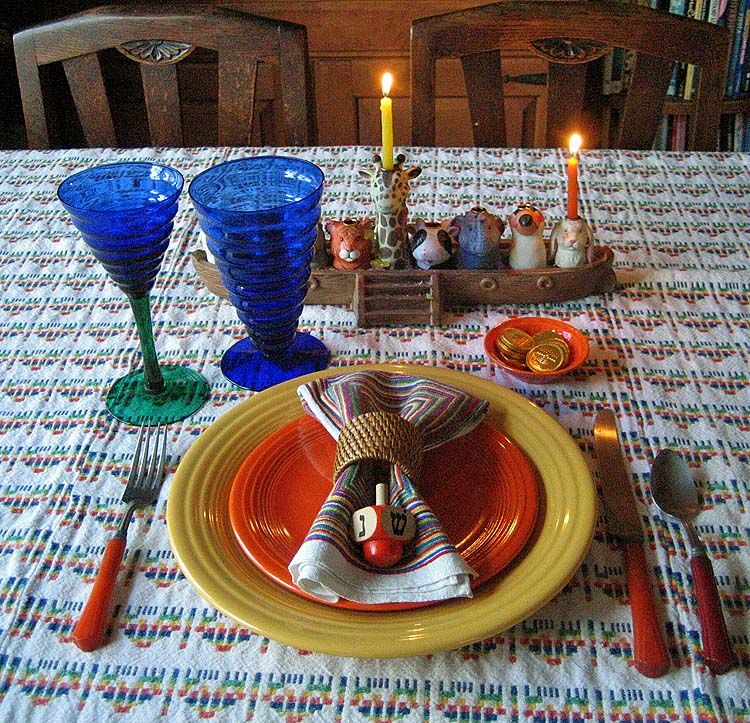
While the candles burn down, children play a game with a dreidel like the wooden top displayed here. There are four Hebrew letters, one on each side of the dreidel: Nun, Gimmel, Hey, and Shin. These are the first letters of the words which make the sentence: (A) Great Miracle Happened There. The winner of each spin (the letters have values) gets some of the gelt--literally money--but usually it's played with foil-covered chocolate coins.
For a more complete description of how to play the game of dreidel, as well as other Hanukkah traditions, check out this site: Holidays.net





.jpg)










 Posts
Posts


